
· Ginebra, Suiza · USA en Vivo · Última Hora
Rueda de prensa de la Organización Mundial de la Salud sobre emergencias sanitarias
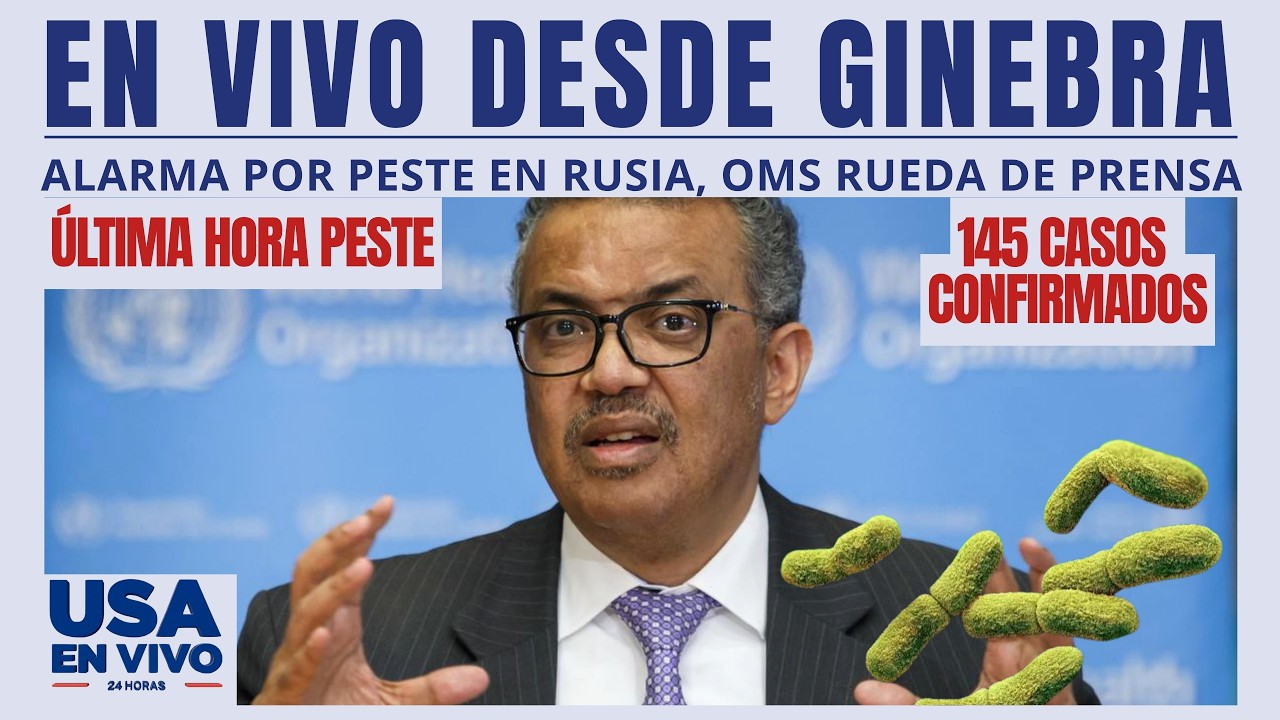
El director general de la OMS, Tedros Adhanom Ghebreyesus, y su equipo técnico evalúan informes sobre un presunto caso mortal de peste neumónica en un instituto de investigación en Rusia. La dirección del organismo detalla las solicitudes de verificación cursadas bajo el Reglamento Sanitario Internacional y aborda otros temas de salud global como el ébola y la obesidad infantil.
Momentos clave
- 1:04 Tedros informa sobre la muerte de una trabajadora en Rusia por sospecha de peste neumónica
- 7:33 Tedros alerta de que la obesidad infantil mundial se cuadruplicó en los últimos 25 años
- 14:07 Van Kerkhove afirma que la OMS espera más respuestas de Rusia sobre el caso de neumonía
- 23:22 Van Kerkhove recuerda que la peste está causada por bacterias y cuenta con tratamiento antibiótico
Transcripción íntegra en español
Transcripción automática de la emisión de USA en Vivo (traducción simultánea con IA del original en inglés). Pulsa la hora para ir a ese punto del vídeo.
0:00 de sustancias. Al otro lado del Dr. Pedros, primero tenemos al Dr. Abdurrahman Mahmud, el director de operaciones de alerta y respuesta ante emergencias de salud. Y por último, pero no menos importante, tenemos a la doctora Pascal Ayotey, directora del departamento de salud sexual y reproductiva, materna, infantil y adolescente y envejecimiento. Tenemos un par de otros colegas en la sala y en línea a quienes acudiremos si surge la situación.
0:26 Ahora, antes de ceder la palabra al doctor Tedros, nuevamente solo él el orden del programa. Primero tendremos los comentarios del doctor Tedros, luego pasaremos a preguntas y respuestas y por favor levanten la mano con el icono de levantar la mano o aquí en la sala, por supuesto, un para entrar en la fila de preguntas. Primero tomaremos normalmente tres preguntas de la sala y luego pasaremos en línea si esta es la situación. Así que muchas gracias por eso y adelante doctor Tedros. Gracias, gracias, Cristian. Eh, buenos días, buenas tardes y buenas noches.
1:04 El viernes pasado, el 2 de octubre surgieron los primeros informes de prensa sobre un caso sospechoso de peste neumónica en un trabajador de laboratorio en el Instituto de Investigación Antipeste de Irkutsk en la Federación Rusa. El trabajador del laboratorio murió después de ser hospitalizado con neumonía grave. Los informes iniciales de los medios sugirieron peste neumónica tras una exposición accidental en el laboratorio. La OMS está al tanto de que el gobierno ruso celebró una reunión el 2 de octubre porque sospechaban que un residente del Oblast de Irkutsk contraído una infección peligrosa. El sábado, la OMS solicitó a la Federación Rusa más información de acuerdo con el reglamento sanitario internacional y ayer la Federación Rusa respondió diciendo que no se había reportado ningún caso de peste recientemente en el Oblast de Irkutsk y que habían puesto en
2:13 cuarentena a unos 200 contactos. However, WHO has requested further information on the lab tests conducted on the individual who died and the contacts more detail on what prompted the public health measures and details about the health status of the contacts. We have also sold verification of media reports of a second employee with pneumonia of undetermined cause. La OMS ha ofrecido apoyo técnico relacionado con la peste y la bioseguridad y bioprotección de laboratorios. Y aún no tenemos una imagen completa de este evento y no podemos realizar una evaluación completa del riesgo.
3:01 El intercambio de información oportuno, completo y transparente bajo el reglamento sanitario internacional es esencial aclarar informes contradictorios y permitir una evaluación precisa de los posibles riesgos para la salud públicas. Ahora sobre la epidemia de ébola en la República Democrática del Congo. El número de casos confirmados ha alcanzado 8665 con 4178 muertes confirmadas. En algunas áreas hay señales claras de que la epidemia está disminuyendo, aunque en otras sigue creciendo. [resoplido] Desde que comenzó el brote, el rastreo de contactos ha mejorado significativamente.
3:44 Se reportan alrededor de 2000 alertas cada día y aproximadamente 5 millones de personas han sido alcanzadas a través de actividades de participación comunitaria. Los ensayos clínicos de terapias están progresando con más de 600 personas inscritas. Se espera que un ensayo de la vacuna comience a finales de este mes y estamos trabajando para garantizar el acceso a estos productos si demuestran ser eficaces en los ensayos. Estos avances son el resultado del arduo trabajo durante muchos meses por parte de comunidades y socios bajo el liderazgo del gobierno. Pero seguimos enfrentando desafíos.
4:24 significativos. La mayoría de las muertes todavía ocurren en la comunidad en lugar de en los centros de tratamiento y el rastreo de contactos aún no está al nivel necesario. Y no podemos olvidar que esta epidemia se está desarrollando en una zona afectada por una prolongada crisis humanitaria. Aunque es la transmisión está disminuyendo, en general siguen apareciendo nuevos focos, incluyendo en áreas cercanas a la frontera con Sudán del Sur. Y como saben, Kenia informó ayer un caso de ébola en un ciudadano keniano que se enfermó en la República Democrática del Congo y fue tratado en varias instalaciones allí. Luego viajó a la capital de Kenia, Nairobi, a través de la capital de Uganda, Campala.
5:15 Inmediatamente al llegar a Nairobi fue llevado al hospital donde fue aislado y se confirmó el ébola. Recibió atención, pero murió el lunes de esta semana. Las autoridades quenas están monitoreando a 55 contactos, incluidos pasajeros y tripulación, que estuvieron con el paciente en el vuelo de Campala a Nairobi. Y este, ayer hablé con el secretario del gabinete para discutir el caso y las medidas. que Kenya había tomado para prepararse para un e para un evento como este.
5:49 Felicito al gobierno de Kenya por su pronta acción y por informar del caso a la OMS bajo el reglamento sanitario internacional de manera oportuna. La OMS desaconseja las restricciones generales de viaje o comercio que son menos efectivas que el cribado, el rastreo de contactos y otras medidas. La transparencia debería ser recompensada, no castigada. Así como saben, hoy se cumplen 3 años desde los horribles ataques de Jamás y otros grupos armados en Israel. Reconozco y respeto el profundo y continuo dolor por esos ataques, especialmente para aquellos que perdieron a alguien que amaban ese día o que fue tomado como reen y no regresó con vida.
6:39 Y he conocido a familias eh varias veces. Este sábado marca un año desde que el alto, el fuego entre Israel y jamás entró en vigor. Un año después, la situación de salud en Gaza sigue siendo crítica y las necesidades de casi 2 millones de personas son abrumadoras. La OMS pide un flujo constante e ininterrumpido de suministros a gran escala para que se restablezcan los servicios de salud y se abran corredores médicos y para que se respete y mantenga el alto el fuego y para lograr una paz duradera y una solución política.
7:23 Hoy la OMS publicó sus primeras directrices abordando el fuerte aumento de la obesidad entre niños y adolescentes. En los últimos 25 años, la prevalencia de la obesidad entre niños y adolescentes se ha cuadruplicado del 2% al 8%. Más de 170 millones de niños y adolescentes en todo el mundo ahora viven con obesidad. En lasanuevas directrices, la OMS recomienda encarecidamente cambios estructurados en la dieta, el comportamiento y la actividad física para niños y adolescentes con obesidad. de las directrices también incluyen consejos sobre tratamiento farmacológico, cirugía bariátrica y dispositivos para la pérdida de peso.
8:08 Las directrices enfatizan que el manejo de la obesidad debe ir más allá de la pérdida de peso y apuntar a mejorar la salud, el funcionamiento y el bienestar. Como siempre, la prevención es mejor que el tratamiento. La OM se sigue pidiendo políticas y medidas que hagan las dietas saludables y la actividad física más accesibles y asequibles. También hoy la OMS y sus socios están lanzando una nueva hoja de ruta global sobre trastornos hipertensivos en el embarazo, incluida la preclamsia. Los trastornos hipertensivos representan alrededor del 16% de las muertes maternas a nivel mundial, resultando en 42,000 muertes y más de 500,000 mortinatos y muertes de recién nacidos.
8:57 En muchos países las mujeres aún carecen de acceso confiable a la medición básica de la presión arterial y al acceso a pruebas y medicamentos esenciales. Los sistemas de referencia débiles, la escasez de trabajadores de salud capacitados y los servicios obstétricos de emergencia limitados pueden retrasar aún más la atención que salva vidas. El nuevo plan de acción global tiene como objetivo abordar una brecha de innovación entre la magnitud del problema y la disponibilidad de medicamentos para prevenir o tratar la preeclamsia. La hoja de ruta tiene como objetivo acelerar la acción de inversión coordinada para asegurar que las intervenciones comprobadas y las futuras innovaciones lleguen a las mujeres y bebés que más las necesitan. Finalmente, este sábado 10 de octubre marca el día mundial de la salud mental.
9:51 Este año nuestro enfoque está en la experiencia vivida de las personas con condiciones de salud mental, especialmente aquellas que han recibido atención institucional. A menudo, estas personas son excluidas de las decisiones sobre cómo se diseñan y reforman los sistemas de salud mental. Muchas son mantenidas en hospitales psiquiátricos involuntariamente durante meses, years años o incluso décadas, aislándolos del mundo exterior. Esta semana la OMS lanzará una guía práctica para apoyar a los países a alejarse del cuidado institucionalizado hacia un cuidado centrado en la persona, en comunidades que respete los derechos y elecciones de las personas. Cristian, de vuelta contigo.
10:38 Muchas gracias, Dr. Tedros. y veo dos manos eh levantadas aquí en la sala, así que comenzaré con pongamos amarillo FP, por favor. Sí. Ah, gracias por tomar mi mi pregunta. Es una pregunta sobre la supuesta plaga en Rusia. Usted mencionó que hay algunos informes de de los medios sobre un segundo empleado con neumonía de causa eh indeterminada.
11:06 Me gustaría preguntarle hasta qué hasta qué punto son son creíbles estos informes y si tiene otra fuente de de información sobre este segundo caso. And y una pregunta también sobre ese asunto más globalmente. Preguntó usted, preguntó la OMS a Rusia si podían enviar un equipo a Rusia en su curso para para ayudar a investigar y recibió más información de Rusia desde ayer al mediodía cuando usted temprano en la mañana cuando recibió algo. Gracias. Thank you. Muchas gracias. Y comenzaremos con la doctora Vanerkov.
11:47 Dr. Vankov. Sí, muchas gracias. Entonces, um sí hay bastante atención UM a esto, así que déjame empezar con lo que sabemos. U, estamos al tanto de informes de un posible caso de sospecha de peste neumónica en en Rusia. Nos hemos comunicado con nuestros colegas en Rusia del Ministerio de Salud para obtener más información y lo que llamamos verificación. Así que es la verificación de la muerte, pero también la verificación de un informe de los medios sobre este segundo caso que ha sido que ha sido mencionado y este es un paso importante.
12:19 Así que nos comunicamos con ellos para hacer preguntas muy detalladas sobre qué pruebas se realizaron, los resultados de esas pruebas de laboratorio, los detalles al respecto, qué análisis adicional se está realizando si la causa aún no se conoce. Wow, qué contactos fueron puestos bajo cuarentena o bajo seguimiento. ¿Qué implicó eso? si el periodo de cuarentena ha terminado, etcétera, etcétera. Así que no tenemos una imagen completa todavía como ha dicho el lo que nos han dicho es que eh no tenían ningún caso de peste registrado eh en esta área que no se detectaron patógenos de alta amenaza. Así que claramente nos gustaría más información para entender qué pruebas de laboratorio se realizaron, qué patógenos se evaluaron y si esta persona no murió de peste, entonces, ¿cómo murió?
13:04 Me gustaría, si puedo, pedir a los medios que por favor dejen de usar el nombre y la foto de esta persona. Lo veo en muchos medios diferentes ahora mismo y debemos deberíamos respetar a todos. Privacidad y privacidad del paciente es solo es solo una petición. Un sé que sigues, uh, ya sabes los protocolos allí, pero por favor si puedo pedir eso. Así que no tenemos esa imagen completa y creo que para nosotros tener una imagen completa de lo que han realizado las autoridades rusas y sí hay diferentes maneras de verificar la información.
13:31 nos comunicamos con nuestros homólogos técnicos en otros países también para verificar un Pero hasta que tengamos esa información es difícil para nosotros hacer una evaluación completa de riesgos. asking further questions. We expect further answers from Russia. Uh we did get some reports back from them following the IHR verification request but not yet everything has been provided to us. [carraspeo] Así que nos hemos comunicado nuevamente haciendo más preguntas, esperamos más respuestas de Rusia.
14:13 Recibimos algunos informes de ellos tras la solicitud de verificación del reglamento sanitario internacional, pero aún no se nos ha proporcionado todo. Gracias. Y esto parece un seguimiento. Sí. Y pidieron enviar un equipo de la OMS al terreno, así que a través de nuestro Gracias. Lo siento, hiciste la segunda pregunta.
14:34 Entonces, UM ofrecido apoyo UM a través de nuestra oficina regional y nuestra oficina en el país en diferentes áreas. Una es enfermedades infecciosas. Ah, particularmente en la peste, pero tenemos personas con experiencia en patógenos de alta amenaza. Um, ella estaba trabajando en un laboratorio antiplaga y así que sabemos el tipo de materiales con los que estaba trabajando. U también hemos ofrecido apoyo en bioseguridad y bioprotección de laboratorio porque algunos de los primeros informes de los medios sugirieron eh un incidente en el laboratorio.
15:01 Así que queremos dar seguimiento, estamos dando seguimiento a esas dos áreas técnicas y si las autoridades rusas lo solicitan, por supuesto, enviaremos personas para apoyar. Gracias. La siguiente pregunta es para Jamie Keiton. Gracias, eh, Dr. Vankov, Jamie Associate Press, ah, solo para aclarar lo que acaba de decir, habló sobre un incidente en el laboratorio. Ah, si pudiera laborar un poco sobre eso, lo que sabe hasta ahora sobre eso, eh, solo para retomar lo que acaba de lo que acaba de decir, pero más ampliamente, eh, solo para aclarar, para reducirlo a una pregunta muy simple. ¿Sabe si esto es, según su entendimiento, una infección viral respiratoria típica o es peste neumónica o simplemente no lo sabe basándose en la información que ha recibido?
15:43 Su declaración de hoy insta a los países a seguir el FRSE. ¿Podría Rusia haber sido más transparente hasta ahora y en el futuro? Y no hemos estado aquí antes de alguna manera. Esto recuerda a muchas personas la situación con China y el brote de COVID. ¿Qué similitudes? Si es que hay alguna está viendo entre esta situación y la que involucró a COVID en China.
16:09 Parece que estamos comenzando con el doctor Bencatarmano. Sí, puedo empezar. Y también tenemos colegas en línea de nuestra oficina en Europa relacionados con el RSI, así que ellos pueden tal vez tal vez mencionar sobre la línea de tiempo. Quiero decir la respuesta simple, Jaie, es que no sabemos exactamente cómo murió esta persona. Sabemos que tenía neumonía. Um, sabemos que fue un caso fatal.
16:26 Um, entendemos que se han realizado algunas pruebas de laboratorio. Um, no han encontrado el agente causante, lo que sabemos, y por eso necesitamos más información. Así que típicamente cuando un laboratorio examina y esta persona trabajaba en un laboratorio de alto riesgo. Entonces, hay muchas disposiciones en estos laboratorios relacionadas con la bioseguridad, la bioprotección. Esta persona habría recibido capacitación, habría tenido vacunas relacionadas con algunos de estos patógenos.
16:48 Este es el tipo de información sobre la que estamos buscando más información. Y desafortunadamente hay personas que mueren de neumonía de lo que decimos causa desconocida. Pero ahora hay métodos en el laboratorio que podemos podemos mirar o ellos pueden mirar para averiguar y determinar cuál fue el agente causante, ya sea a través de pruebas PCR o mediante secuenciación genética o metagenómica. Hay todo un área de trabajo sobre esto. Así que trabajamos con nuestros estados miembros, incluido Rusia.
17:14 Pero si Rusia necesita apoyo de otros laboratorios, estamos más que felices de hacer esas conexiones. Pero diré que hay una buena conexión global entre laboratorios en cuanto al apoyo para esto. Así que si nos piden apoyo técnico, estamos más que felices de proporcionarlo. Y sabes, tú preguntas sobre si se debería haber proporcionado más, creo que la respuesta simple es siempre sí y necesitamos eh necesitamos informes transparentes y oportunos de todos nuestros estados miembros. es realmente importante para la no solo para compartir información, sino para la evaluación de riesgos y luego alertamos al resto del mundo a todos nuestros estados miembros y a nuestros uos focales nacionales del RSI a través de un a través de un a
17:52 través de un sistema que utilizamos hoy. Informamos sobre este incidente a todos nuestros estados miembros y a los puntos focales NFP y luego estaremos publicaremos un don, un boletín de noticias sobre brotes de enfermedades que es público y además por supuesto tener estos. Así que sí, necesitamos más información y esperamos que eso llegue de manera oportuna. Te hice varias preguntas solo sobre el incidente en el laboratorio. Pues tienes que qué sabes sobre eso?
18:20 Yo yo sé lo que sabes por los medios de un de un tubo de ensayo rompiéndose y exposición, pero de nuevo alguien trabajando en un laboratorio en un laboratorio de patógenos de alta amenaza estará usando EPP. Así que estábamos investigando, ya sabes, qué tipo de EPP, equipo de protección personal, eh, perdón, se usaría, bajo qué condiciones, qué estaban haciendo con estos patógenos. Así que tenemos bioseguridad de laboratorio, bioseguridad exfuerzos. Aquí trabajamos con varios de ellos en todo el mundo para obtener más información, pero no tengo detalles sobre lo que eso podría ser. Incidente suena como una palabra aterradora.
18:51 Sé séo y sé que todos estamos reflexionando sobre, digamos, eventos pasados. Nosotros como organización queremos asegurarnos de que no estamos demasiado confiados en la información que tenemos, que estamos siguiendo activamente con Rusia y que aún no tenemos toda la información. Gracias. Y creo que teníamos la parte de la línea de tiempo del RSI y queremos [resoplido] pasar al Dr. Silvio Yumanú de la oficina de la OMS en Europa, las operaciones de alerta e inteligencia en salud pública. Silvio, te cedo la palabra.
19:25 Ah, buenos días. Buen día, buenas tardes a todos. Ah, gracias por la pregunta. Entonces, en términos del RC, obviamente una vez que tuvimos las señales de los medios, enviamos una solicitud de verificación, como mencionó María sobre el artículo y cuando recibimos la respuesta de las autoridades estaba escrito porque sospechábamos por los medios que era una infección adquirida en el laboratorio y la respuesta fue que es una neumonía grave adquirida en la comunidad de etiología desconocida. Así que lo que sabemos es que actualmente es negativo para para la alta amenaza o para los patógenos que han sido probados.
20:02 Es en un miembro del personal de la instalación de investigación, pero no hay basado en en el texto proporcionado por las autoridades rusas, no hay un vínculo causal entre somos conscientes de los problemas para hacer cumplir las enmiendas del RSI. Y creo que esa es parte de la razón por la que se inició el proceso de enmiendas del RSI y se hizo efectivo en septiembre de 2025 el año pasado. También en un intento de mejorar la aplicación del RSI en el mejor principio de solidaridad posible. Gracias. Y de vuelta a la sala.
20:42 Muchas gracias, Silviu. Y esto fue solo porque el nombre no está en la en la lista e para ti. Esto fue el doctor Silvio Giovanu, C o BU de la OMS Euro operaciones de alertas e inteligencia en salud pública. Gracias. La siguiente pregunta va en línea y es para Jen Rigby de Reuters. Chen, por favor, adelante. Hola, gracias por tomar mi pregunta.
21:13 Eh, solo quería preguntar, ¿no podemos encontrar un informe medios creíble sobre un segundo caso. Eh, ¿puede decirnos dónde se publicó ese informe o señalarnos hacia él? Y si no, ¿por qué mencionaron ese segundo caso? ¿Tienen alguna otra información al respecto? Posible segundo caso, ¿verdad?
21:27 Que eso ha sido reportado. Y luego solo una verificación rápida. dijiste que no puedes hacer una evaluación completa de riesgos en este momento porque no tienes toda la información. Eso es un cambio respecto a cuando dijiste ayer que la amenaza hasta ahora parece baja. Según lo que sabes, e, ha cambiado algo o sigues diciendo lo mismo.
21:46 Crec, por favor. Sí, gracias. podemos enviar el enlace al informe de los medios que habíamos visto. Y de nuevo, esto es algo que en la OMS hacemos todo el tiempo. Estamos evaluando decenas de miles de señales, algunas de estas provienen de los medios, algunas de otras fuentes y es importante para nosotros verificar eso. Así que hemos enviado ese enlace a nuestros colegas en Rusia para verificar este posible segundo caso.
22:07 Así que podemos compartir ese enlace, tendremos que hacerlo en el chat. un con respecto a la evaluación de riesgos, sí hemos dicho y el DG ha dicho que no tenemos el panorama completo para hacer una evaluación de riesgos completa. Siempre hacemos una evaluación de riesgos inicial, estamos haciendo nuevamente evaluaciones de riesgos todo el tiempo basadas en la información que tenemos. Se actualizará regularmente a medida que haya más información disponible. Yo tal vez esta sea una buena oportunidad para mencionar la peste en general.
22:35 Um, y lo que sabemos sobre la peste. Quiero decir, hay miles de casos de peste sospechosa cada año que ocurren en todo el mundo. Hay peste bubónica y hay peste neumónica. Un Los informes sobre la peste cambiaron durante el periodo de COVID porque no muchas personas estaban haciendo pruebas para esto. Y así recientemente publicamos un artículo sobre casos de peste desde 2019 y desde 2019 hasta 2025.
23:00 10 países reportaron casi 4,000 casos humanos sospechosos de peste y 423 muertes. Así que solo quiero contextualizar esto. Asia central tiene el mayor número de eh los los focos, los los como la gente se infecta. Así que estos pequeños roedores se infectan e y a veces hay algunos pequeños brotes esporádicos. So, entonces la peste es una bacteria, es causada por una bacteria.
23:27 Hay antibióticos que pueden tratar esto, así que si alguien tiene una infección con peste se puede tratar. Entonces, obviamente la atención clínica temprana y una buena concienciación sobre esto son realmente importantes. Pero quiero contextualizar esto. Cuando hacemos una evaluación de riesgos, miramos la información que tenemos sobre el evento, pero también la ponemos en contexto con lo que sabemos sobre el patógeno en sí. Omolveré a decir que ahora mismo no sabemos el agente causante de cómo murió esta mujer y eso es realmente lo que queremos entender mejor.
23:55 Las autoridades en Rusia pusieron aproximadamente a 200 personas en cuarentena o bajo seguimiento cercano. Estamos siguiendo los detalles relacionados con eso. ¿A quiénes son estas personas? ¿Qué tipos de exposiciones pueden haber tenido? ¿Eran trabajadores de la salud, etcétera?
24:10 ¿Qué tipos de pruebas se realizaron? Entonces toda esa información nos ayuda a entender el riesgo localmente, el riesgo a nivel nacional dentro de Rusia, a nivel regional y también global. Entonces, eh por eso no tenemos eh se ha realizado una evaluación de riesgos completa, pero siempre estaremos haciendo evaluaciones de riesgos iniciales y le informaremos cuando se realicen nuevamente. Muchas gracias, María. Primero queremos ir con el doctor Abdi Mahmud. Gracias. Entonces, solo para ampliar lo que dijo María sobre cómo lo hace la OMS, es su vigilancia basada en eventos.
24:45 Diariamente revisamos todos los medios utilizando nuestra epidemia. entre la inteligencia o fuentes abiertas. Nuestro centro en Berlín ha desarrollado un buen sistema utilizando inteligencia artificial, así que podemos captar casi todos los idiomas, todos los artículos de noticias, incluso desde regionales a diferentes. Eh, así que captamos esas señales, eh, lo que llamamos una señal. Entonces, desde allí pasamos por un sistema de triangulación.
25:08 es esto fiable, apoya el evento en curso, así que hay un equipo sistemático que hace eso a diario. Tenemos un turno de 24 horas, 24 horas al día, 7 días a la semana, nuestro oficial de turno lo hace, así que elegimos este evento. Tal vez el sitio ya no esté activo, no lo sabemos, pero lo hacemos y mantenemos la captura de pantalla de todo como lo hacemos. Y luego de ahí pasamos a la evaluación, como dijo Silvio, y si vemos que es creíble basándonos en la triangulación de los datos, vamos a un estado miembro para verificar ese evento. Así que hay una evidencia rigurosa basada en la ciencia y no descartamos, pues si el artículo de noticias es digno, no emitimos ese juicio.
25:47 Siempre que ocurra en el contexto de un brote, lo detectamos y luego tomamos las medidas necesarias. Así que solo quería decir que la OM se seleccionó este artículo en en Rusia y usamos eh nuestras oficinas regionales que se encargan de eso. Así que solo quería decir eso, no es que la OMS haya elegido algo al azar eh true a través del sistema establecido en ellos y nuestro centro en Berlín. Podemos hacerlo en todos los idiomas, ya sea ruso, chino, inglés o incluso todos los idiomas locales. Tenemos un sistema robusto, capaz de construir sobre lo que se informa oficialmente.
26:25 No necesitábamos hacer eso para Kenya porque Kenia informó de inmediato, pero si Kenia no hubiera informado, lo habríamos detectado a través de los medios o de las redes sociales. Así que solo quería aclarar el proceso que usamos para captar señales signals. Muchas gracias por esa aclaración tan importante. La siguiente pregunta también es en línea y es de Prettypad Nike de Geneva Health Files. Por favor, Pretty.
26:52 Buenas noches. Gracias por tomar mi pregunta. Eh, tenía algunas preguntas en realidad. Una es si puede contarnos un poco más sobre ah el laboratorio en en Siberia. Eh, ¿cómo entenderíamos qué grado de laboratorio era? ¿Tenían suficientes medidas de bioseguridad?
27:09 bioseguridad eh en virtud de su grado. Y la segunda es la comunicación que recibió de Rusia fue bajo canales formales del RSI, la notificación o fue en respuesta a su consulta, cómo entenderíamos la naturaleza de la respuesta de Rusia. Y finalmente, en la línea de tiempo u entendemos que yo bajo bajo la RI, los países están obligados a responder dentro de 24 horas. es eh así que solo estoy tratando de entender si ellos eh respondieron dentro de las 24 horas o si todavía están buscando información un respecto a como se espera bajo el RSI. Muchas gracias. Sí, gracias por eso y supongo que volvemos con el doctor Silvio sobre los procedimientos del RCI.
28:04 Gracias por la pregunta. un en el RCI tenemos el anexo 2, que es un instrumento de toma de decisiones que ayuda a los países, ayuda a los estados, partes de la RSI a decidir si notificar a la OMS sobre algo o no. Básicamente hay cuatro preguntas o preguntas clave. ¿Qué tan grave es el impacto en la salud pública?
28:26 es inusual y esperado, representa un riesgo de propagación internacional y representa un riesgo de restricciones comerciales o de viaje. Uh, hay algunas enfermedades notificables por defecto, pero no hablaremos de esas. Entonces, cada estado miembro al enfrentar una situación como esta, usualmente usaría este anexo dos, revisará las preguntas y dependiendo de las respuestas de se les aconsejará notificar o consultar a la OMS o no. eh para responder a la pregunta en sí, eh no no fue una una notificación bajo el artículo 6, fue una respuesta a una solicitud de verificación bajo el artículo 10. Eh, en cuanto al plazo, creo que sí eh es muy explícito en que eh se espera una respuesta dentro de 24 horas y luego de eso las partes del estado pueden requerir un poco más de tiempo para eh recopilar toda la información adicional.
29:20 Así que esto es en resumen, dejaré la respuesta sobre el nivel de bioseguridad del laboratorio a otros colegas. U, solo sé lo que está en el dominio público sobre el laboratorio. Muchas gracias, Silvio. Y para la pregunta del laboratorio sobre María, ya no. Y también solo para complementar eso, ¿sabes? Cuando la información se proporciona a través del RS al responder la pregunta, siempre volvemos y hacemos preguntas adicionales, así que eso es algo bastante típico para nosotros y en este caso no es diferente.
29:52 Entonces, al recibir información de Rusia sobre el caso, hemos vuelto con más preguntas y eso continuará hasta que obtengamos las respuestas que realmente necesitamos para uno, entender la situación y dos entender el riesgo que representa no solo para Rusia sino para todos los demás. Así que es importante para nosotros dar seguimiento y el RSI está destinado para eso. El RSI está construido para eso. Esas son las regulaciones sanitarias internacionales que los estados miembros y las partes del Estado han acordado. En cuanto al laboratorio en sí, hacemos mucho trabajo con laboratorios alrededor del mundo, particularmente en lo que respecta a la bioseguridad y la bioprotección en laboratorios.
30:30 UM tenemos manuales UM sobre cómo deberían operar estos laboratorios. Depende de la naturaleza de lo que hace el laboratorio, con qué patógenos están trabajando, qué tipo de métodos están usando dentro de los laboratorios. Solíamos llamar a estos nivel de bioseguridad 2 3 4 UM y queremos asegurarnos de que las provisiones correctas estén en su lugar. Muchos de estos laboratorios ah también son evaluados por los gobiernos ah donde están ubicados donde donde residen ah para asegurarse de que cumplan con las regulaciones con las leyes asociadas con trabajar UM en esos países y trabajar con esos patógenos. Um, voy a dejar que mi colega responda y tendré que volver a usted quizás sobre algunos de los detalles específicos de este laboratorio en sí, pero puedo decirle que trabajamos con laboratorios para asegurar un la bioseguridad y la bioprotección adecuadas, pero depende del
31:19 país y del propio laboratorio asegurar que se lleve a cabo un si hubiera un incidente en este laboratorio, hay procedimientos que deben seguirse. En términos de la evaluación que hacen en el laboratorio, habría profilaxis postexposición, por ejemplo, para esta persona. Probablemente realizarían pruebas. Así que hay más por venir en cuanto a lo que realmente sucedió allí, si es que sucedió algo, pero queremos asegurarnos de que yo yo quiero asegurarme de que tenemos la información correcta antes de compartirla contigo y aún no tengo esa imagen completa. Thank you. Muchas gracias a ambos.
31:55 La siguiente pregunta es para Naomi Crasque de Bloomberg. Naomi, adelante. Hola, gracias por tomar mi pregunta. Eh, quería volver a preguntar sobre si la evaluación de bajo riesgo de ayer sigue vigente, sigue siendo así, ¿eh? o ha cambiado el riesgo o simplemente no pueden decir en este momento cuál es el riesgo.
32:27 Y luego en segundo lugar respecto a las 200 personas que fueron puestas en cuarentena o bajo seguimiento cercano. Um, la declaración de esta mañana creo que decía que esta evaluación médica se había completado. Eh, eso significa que las personas ya no están en cuarentena o puedes darnos más información sobre dónde están esas personas ahora y cuál es su estado? Gracias. Correcto. Muchas gracias. ¿Por qué deberíamos comenzar de nuevo con la Draora María Banc?
32:55 Puedo comenzar y si otros quieren complementar, por favor háganlo. Así que solo reiteraré sobre Permítanme comenzar con la segunda parte de de su pregunta con respecto a los contactos que están en cuarentena o estuvieron en cuarentena. Esta es una pregunta específica que hemos seguido con Rusia. Eh, ¿quiénes son estos aproximadamente 200 contactos? Por ejemplo, eran trabajadores de la salud, son exposición ocupacional, son amigos y familiares.
33:20 Ah, ¿quiénes son estas personas? ¿Cuál es la naturaleza de la cuarentena o el seguimiento eh que han tenido? ¿Qué tipos de pruebas se han realizado y el periodo está realmente completo? Um, no tenemos la línea de tiempo completa del inicio de los síntomas de la mujer que murió. Um, también sabemos que hay otros patógenos que están circulando.
33:40 U, de algunos de los informes que hemos visto, sabemos que COVID-19 está presente, sabemos que el rino virus está presente, así que necesitamos más información sobre quién estaba en cuarentena, dónde estaban, dónde están, UM y cuál es el estado, cuál es realmente su estado de salud. Nos informaron que ninguno de los contactos ha desarrollado síntomas y esto es algo sobre lo que estamos pidiendo más información. Así que desafortunadamente eso es lo que puedo decirte al respecto por el momento. En cuanto al riesgo, como mencioné, hemos hecho una evaluación inicial de riesgos. Siempre haremos esto y lo que se dijo ayer fue lo que dijimos inicialmente.
34:16 También quiero aclarar y Abdi quizás quieras comentar sobre esto también cuando hacemos evaluaciones de riesgo, miramos diferentes poblaciones, evaluaciones de riesgo para el entorno, ya sabes, para individuos que están expuestos a cualquier patógeno del que estemos hablando. Hacemos evaluaciones de riesgo y hacemos u juicios ujuicios iniciales relacionados con el riesgo u para el público en general. Y aquí cuando hablamos del público en general y miramos el re, el país, la región, el mundo, ciertamente uh esta es una situación en la que no estamos no tenemos evidencia que sugiera algo diferente, sin embargo, no tenemos toda la información. Por eso estoy tratando de ser cauteloso cuando decimos que no hemos hecho una evaluación completa de riesgos, porque no tenemos toda la información. Muy bien, muchas gracias.
35:04 La siguiente pregunta, ya que no veo ninguna en la sala. Ah, un Oh, lo siento, Abdi, estabas escondido detrás. No, solo basándome en lo que en lo que dijo María. Eh, la evaluación inicial de riesgo se basó la información que obtuvimos. Esto fue, entre comillas, peste neumónica y eh de la OMS.
35:22 Y más tarde, cuando obtuvimos el resultado, no tenemos suficiente información para hacer la evaluación de riesgos para una mayor propagación del riesgo global. Así que hay un criterio claro. Entonces, nuestra evaluación inicial de riesgo se basó en entre comillas peste neumónica, que es eh bien conocido y hemos hecho muchas evaluaciones de de riesgo. Tuvimos un gran brote de peste neumónica en Madagascar y es endémica, es una enfermedad que conocemos, pero al obtener la actualización de allí no tenemos suficiente información para hacer la evaluación de riesgos. Así que las dos declaraciones no son contradictorias.
35:53 Se basó en la evaluación inicial. Durante evaluación actual OMS no tenemos suficiente información para hacer una evaluación de riesgo. ¿Sobre qué? ¿Con qué patógeno estamos tratando? Hablamos sobre la propagación internacional, el riesgo para la salud humana. Todos los aspectos y la probabilidad de eso tienen que ser específicos para ese patógeno.
36:11 Así que hasta que obtengamos más información no podemos hacer una evaluación de riesgos. Gracias por una aclaración muy importante. Ahora tenemos una pregunta en la sala. Agnes Perrón, AFP. Sí, una pregunta de seguimiento sobre algo que que mencionaste en algún momento.
36:29 ¿Dices que Rusia dijo que es una enfermedad adquirida en la comunidad u neumonía? Un ¿podrías explicar qué significa? Y significa que la la ha sido esta persona podría haber sido contaminada por community, personas de la comunidad afuera y eso significa que podría haber algún tipo de epidemia allí. ¿Qué significa? Gracias. Ya, thank you. Sí, gracias. y y luego de hecho pediré que vayamos a nuestros colegas en en euro también para hablar sobre la neumonía adquirida en la comunidad, particularmente en la región, pero sí quiero decir, de hecho, no entendemos cómo se infectó.
37:03 Entonces, los informes iniciales fueron potencialmente una exposición en el laboratorio y, por supuesto, porque ella trabajaba en un laboratorio antiplaga, circunstancialmente suena bastante un eso podría ser una una fuente potencial de su exposición, pero sí la gente tiene neumonía por muchos tipos diferentes de patógenos. ya sean virus o bacterias que circulan naturalmente. Estamos hablando de un área bastante remota eh en Rusia, en Siberia. Sabemos que hay otros patógenos circulando, COVID-19, rinovirus fueron dos que se reportaron, pero por supuesto hay otros tipos de patógenos. Así que adquirido en la comunidad sí significaría fuera del laboratorio.
37:39 Pero de nuevo lo que queremos saber eh cuando alguien ha muerto y y particularmente en este caso, como esta persona no estaba, ¿con qué estaba infectada? Número uno. Y en segundo lugar, una vez que sepamos eso, eh, cómo se infectó y lo que es importante, lo que el país estaba haciendo para dar seguimiento. Así que en este caso identificaron 200 contactos para dar seguimiento. Y creo que eso es realmente importante porque desde el punto de vista del riesgo, desde el punto de vista de la salud pública, querrías identificar y lo que inicialmente sospecharon fue peste neumónica y eso es lo que también habíamos escuchado. Si eso se descarta, dicen que eso se descarta de que murió realmente.
38:14 Así que no estoy seguro si los colegas en euro quieren intervenir particularmente sobre la neumonía adquirida en la comunidad. Sí, veamos a los colegas. Tal vez el doctor Iju o Perinit. Thank you, María. Gracias, María. No, nada que añadir desde desde esa perspectiva.
38:31 Esos son exactamente los los parámetros. La neumonía adquirida en la comunidad significa, según la notificación, información de la Federación Rusa, que creen que no proviene del laboratorio. Y eso es el el C. Claro, patógenos que causaron la neumonía. Esta información aún estamos esperando recibirla para hacer una mejor evaluación de riesgos y una evaluación clara de riesgos basada en información más factual sobre la causa de la muerte de un caso que fue reportado primero en los medios públicos y luego seguimos a
39:06 través de los canales del RSI. Cambio. Muchas gracias, doctora Verenic por este aporte. La siguiente pregunta es ahora para Helen Helen Brandwat. Helen, por favor, adelante.
39:23 Hola, gracias. Tengo un par de preguntas. En primer lugar, me gustaría retomar la pregunta de Jen Rakby de antes cuando preguntó por qué la OMS, por qué el director general mencionó el segundo posible caso de neumonía en sus comentarios iniciales. Ha habido discusión sobre todo el análisis de inteligencia que la OMS realiza a diario. Debemos concluir del hecho de que esto se haya
Transcripción original en inglés
0:00 substances. On the other side of Dr. Pedros, first we have Dr. Abdurrahman Mahmud, the director of health emergency alert and response operations. And last but not least, we have Dr. Pascal Ayotey, the director of the department of sexual and reproductive, maternal, child and adolescent health and ageing.
0:21 We have a couple of other colleagues in the room and online who we will turn to if the situation arises. Now, before I give the floor to Dr. Tedros, again just him, the order of the program. First we will have Dr. Tedros ' remarks, then we will move to questions and answers and please raise your hand using the raise hand icon or here in the room, of course, a to join the question queue.
0:47 We will normally take three questions from the room first and then we will go online if that is the situation. So thank you very much for that and go ahead Dr. Tedros. Thank you, thank you, Cristian. Uh, good morning, good afternoon and good evening.
1:06 Last Friday, October 2, the first press reports emerged about a suspected case of pneumonic plague in a laboratory worker at the Irkutsk Anti-Plague Research Institute in the Russian Federation. The laboratory worker died after being hospitalized with severe pneumonia. Initial media reports suggested pneumonic plague following accidental exposure in the laboratory. WHO is aware that the Russian government held a meeting on October 2 because they suspected a resident of the Irkutsk Oblast had contracted a dangerous infection. On Saturday, WHO requested further information from the Russian Federation in accordance with international health regulations and as of yesterday the Russian Federation responded saying that no cases of plague had been reported recently in the Irkutsk Oblast and that they had quarantined about
2:14 200 contacts. However, WHO has requested further information on the lab tests conducted on the individual who died and the contacts more detail on what prompted the public health measures and details about the health status of the contacts. We have also sold verification of media reports of a second employee with pneumonia of determined cause. WHO has provided technical support related to plague and laboratory biosafety and biosecurity. And we do not yet have a complete picture of this event and cannot conduct a full risk assessment.
3:01 Timely, complete and transparent information sharing under the International Health Regulations is essential to clarify conflicting reports and allow for an accurate assessment of potential public health risks. Now about the Ebola epidemic in the Democratic Republic of the Congo. The number of confirmed cases has reached 8,665 with 4,178 confirmed deaths. In some areas there are clear signs that the epidemic is declining, while in others it is still growing. Since the outbreak began, contact tracing has improved significantly.
3:45 Around 2,000 alerts are reported each day and approximately 5 million people have been reached through community engagement activities. Clinical trials of therapeutics are progressing with over 600 people enrolled. A vaccine trial is expected to begin later this month, and we are working to secure access to these products if they prove effective in trials. These developments are the result of hard work over many months by communities and partners under the leadership of the government. But we continue to face significant challenges.
4:27 Most deaths are still occurring in the community rather than in treatment facilities, and contact tracing is not yet at the level needed. And we cannot forget that this epidemic is unfolding in an area affected by a protracted humanitarian crisis. While transmission is decreasing, overall new clusters continue to emerge, including in areas close to the border with South Sudan. And as you know, Kenya yesterday reported a case of Ebola in a Kenyan national who became ill in the Democratic Republic of Congo and was treated at several facilities there. He then traveled to the Kenyan capital, Nairobi, via the Ugandan capital, Kampala.
5:15 Immediately upon arrival in Nairobi, he was taken to hospital where he was isolated and was confirmed to have Ebola this week. Kenyan authorities are monitoring 55 contacts, including passengers and crew, who were with the patient on the flight from Campala to Nairobi. And yesterday, I spoke with the Cabinet Secretary to discuss the case and the measures that Kenya had taken to prepare for an event such as this. I commend the government of Kenya for its prompt action and for reporting the case to the WHO under the international health regulations in a timely manner. The WHO advises against blanket restrictions on travel or trade that are less effective than screening, contact tracing and other measures.
6:12 Transparency should be rewarded, not punished. As you know, today marks three years since the horrific attacks by Hamas and other armed groups in Israel. I acknowledge and respect the deep and ongoing grief over those attacks, especially for those who lost someone they loved that day or who was taken prisoner and did not return alive. And I have met with families several times. This Saturday marks one year since the ceasefire between Israel and the United States came into effect.
6:52 One year on, the health situation in Gaza remains critical and the needs of nearly 2 million people are overwhelming. WHO is calling for a sustained and uninterrupted flow of large-scale supplies to restore health services and open medical corridors, to ensure that the ceasefire is respected and maintained, and to achieve a durable peace and political solution. Today, WHO released its first-ever guidelines addressing the sharp rise in obesity among children and adolescents. Over the past 25 years, the prevalence of obesity among children and adolescents has quadrupled from 2 % to 8 %. More than 170 million children and adolescents worldwide now live with obesity.
7:49 In the new guidelines, WHO strongly recommends structured changes in diet, behavior and physical activity for children and adolescents with obesity. The guidelines also include advice on pharmacological treatment, bariatric surgery and weight loss devices. The guidelines emphasize that obesity management must go beyond weight loss and aim to improve health, functioning and well-being. As always, prevention is better than treatment. The WHO continues to call for policies and measures that make healthy diets and physical activity more accessible and affordable.
8:34 Also today, WHO and partners are launching a new global roadmap on hypertensive disorders in pregnancy, including pre-eclampsia. Hypertensive disorders account for around 16 % of maternal deaths globally, resulting in 42,000 deaths and over 500,000 stillbirths and newborn deaths. In many countries, women still lack reliable access to basic blood pressure measurement and access to essential tests and medicines. Weak referral systems, a shortage of trained health workers, and limited emergency obstetric services can all serve to further delay the provision of essential, life-saving medical care. The new global action plan aims to address an innovation gap between the scale of the problem and the availability of medicines to prevent or treat preeclampsia.
9:30 The roadmap aims to accelerate coordinated investment action to ensure that all proven interventions and future innovations reach the women and babies who are in the greatest need of these resources. Finally, this Saturday, October 10, marks World Mental Health Day. This year, our focus is on the lived experience of people with mental health conditions, especially those who have received institutional care. These people are often excluded from decisions about how mental health systems are designed and reformed. Many are kept in psychiatric hospitals involuntarily for months, years or even decades, isolating them from the outside world.
10:21 This week, WHO will launch practical guidance to support countries in moving away from institutionalized care towards person-centered care, in communities that respect people’s rights and choices. Cristian, back to you. Thank you very much, Dr. Tedros. and I see two hands up here in the room, so I'll start with >> yellow FP, please. >> Yes. Oh, thank you for taking my question.
10:54 It's a question about the alleged plague in Russia. You mentioned that there are some media reports about a second employee with pneumonia of undetermined cause. I'd like to ask you to what extent these reports are credible and if you have any other sources of information about this second case. And and a question also about that issue more globally. You asked, the WHO asked Russia if they could send a team to Russia in their course to help investigate and you received more information from Russia since yesterday at noon when you received something early this morning.
11:42 Thank you. >> Thank you. Thank you very much. And we'll start with Dr. Vankov. Dr. Vankov. >> Yes, thank you very much.
11:51 So, um, there is quite a bit of attention um to this, so let me start with what we know. um, we are aware of reports of a possible suspected case of pneumonic plague in Russia. We have reached out to our colleagues in Russia at the Ministry of Health to get more information and what we call verification. So it's verification of the death, but also verification of a media report about this second case that has been mentioned and this is an important step. So we reached out to them to ask very detailed questions about what tests were performed, the results of those lab tests, the details around that, what additional testing is being done if the cause is not yet known.
12:33 Wow, which contacts were quarantined or under surveillance. What did that entail? Whether the quarantine period has ended, etc. , etc. So we don't have a full picture yet as you said what they have told us is that uh they did not have any registered cases of plague in this area that no high-threat pathogens were detected. So clearly we would like more information to understand what lab tests were performed, what pathogens were tested for and if this person did not die of plague, then how did they die?
13:04 I would like to, if I may, ask the media to please stop using this individual's name and photo. I see it in many different media outlets right now and we should respect everybody. Privacy and patient privacy is just a request. Um, I know you follow, uh, you know the protocols there, but please if I can ask that. So we don't have that full picture and I think for us to have a full picture of what the Russian authorities have done and yes there are different ways to verify information.
13:32 We are reaching out to our technical counterparts in other countries as well to verify a... But until we have that information it's difficult for us to do a full risk assessment. asking further questions. We expect further answers from Russia. Uh we did get some reports back from them following the IHR verification request but not yet everything has been provided to us.
14:07 >> So we have reached out again asking further questions, we expect further answers from Russia. Uh we did get some reports back from them following the IHR verification request but not yet everything has been provided to us. >> Thank you. And this looks like a follow-up. >> Yes. And they asked to send a WHO team to the field, so through our Thank you.
14:33 Sorry, you asked the second question. So, UM has offered support UM through our regional office and our country office in different areas. One is in infectious diseases. Um, particularly in plague, but we have people with expertise in high-threat pathogens. Um, she was working in a plague lab and so we know the types of materials that she was working with.
14:53 Um, we've also offered support in biosafety and biosecurity of the laboratory because some of the early media reports suggested uh an incident in the lab. So we want to follow up, we're following up in those two technical areas and if the Russian authorities request it, of course, we will send people to support. Thank you. The next question goes to Jamie Kiton. Thank you, uh, Dr. Vankov, Jamie Associate Press, uh, just to clarify what you just said, you talked about an incident in the lab.
15:21 Oh, if you could elaborate a little bit on that, what you know so far about that, uh, just to pick up where you just said it, but more broadly, uh, just to clarify, to boil it down to a very simple question. Do you know whether this is, to your understanding, a typical respiratory viral infection or is it pneumonic plague or do you just not know based on the information that you've received? Your statement today urges countries to follow the FRSE. Could Russia have been more transparent up until now and in the future?
15:53 And we haven't been here before in some ways. This reminds a lot of people of the situation with China and the COVID outbreak. What similarities, if any, are you seeing between this situation and the one involving COVID in China. >> It sounds like we're starting with Dr. Bencatar, brother.
16:11 >> Yes, I can start. And we also have colleagues online from our office in Europe who are involved with the IHR, so they can perhaps touch on the timeline. I mean the simple answer, Jamie, is we don't know exactly how this person died. We know that he had pneumonia. Um, we know that it was a fatal case.
16:26 Um, we understand that some laboratory tests have been done. Um, they haven't found the causative agent, which we know, and that's why we need more information. So typically when a laboratory tests and this person worked in a high-risk laboratory. So, there are a lot of provisions in these laboratories related to biosafety, biosecurity. This person would have had training, would have had vaccinations related to some of these pathogens.
16:48 This is the type of information that we're looking for more information on. And unfortunately there are people who die from pneumonia of what we say unknown cause. But there are now methods in the laboratory that we can look at or they can look at to find out and determine what the causative agent was, whether it's through PCR testing or through genetic sequencing or metagenomics. There's a whole area of work on this. So we work with our member states, including Russia.
17:15 But if Russia needs support from other laboratories, we're more than happy to make those connections. But I will say that there is a good global connection between laboratories in terms of support for this. So if they ask us for technical support, we are more than happy to provide it. And you know, you ask about whether more should have been provided, I think the simple answer is always yes and we need uh we need transparent and timely reporting from all of our member states. It's really important for not only sharing information but for risk assessment and then we alert the rest of the world to all of our member states and to our national IHR focal points through a through a through a through a system that we
17:52 use today. We reported this incident to all of our member states and to the NFP focal points and then we will be putting out a don, a disease outbreak newsletter that is public and also of course having these. So yes, we need more information and we hope that that comes out in a timely manner. I >> asked you several questions just about the incident at the laboratory. Well, you have to know about that. >> I know what you know from the media, like a test tube breaking and exposure, but again, somebody working in a lab, in a high-threat pathogen lab, would be wearing PPE.
18:31 So we were investigating, you know, what kind of PPE, personal protective equipment, uh, sorry, would be used, under what conditions, what were they doing with these pathogens. So we have laboratory biosafety, biosecurity efforts. We're working with a number of them around the world to get more information, but I don't have any specifics on what that might be. Incident sounds like a scary word. I know, and I know we're all reflecting on, let's say, past events.
18:57 We as an organization want to make sure that we're not overconfident in the information that we have, that we're actively following up with Russia, and we don't have all the information yet. Thank you. And I think we had the IHR timeline piece, and we want to turn it over to Dr. Silvio Yumanú from the WHO Office for Europe, Public Health Intelligence and Alert Operations. Silvio, over to you. Oh, good morning.
19:25 Good morning, good afternoon, everyone. Oh, thank you for the question. So, in terms of the RC, obviously, once we had the media signals, we sent a verification request, as Maria mentioned, about the article. And, when we got the response from him, the authorities, it was written because we suspected from the media that it was a laboratory-acquired infection, and the response was that it is severe community-acquired pneumonia of unknown etiology. So what we know is that it is currently negative for the high-threat or the pathogens that have been tested.
20:03 It is in a staff member of the research facility, but there is no causal link based on the text provided by the Russian authorities, we are not aware of any problems in enforcing the IHR amendments. And I think that is part of the reason why the IHR amendment process was initiated and became effective in September 2025 last year. Also in an attempt to improve the application of the IHR in the best possible principle of solidarity. Thank you. And back to the floor.
20:42 Thank you very much, Silviu. And this was just because the name is not on the list and for you. This was Dr. Silvio Giovanu, C or B A N UU of WHO Euro Public Health Intelligence and Alert Operations. Thank you. The next question goes online and it's for Jen Rigby from Reuters. Chen, please go ahead.
21:11 >> Hi, thanks for taking my question. Uh, I just wanted to ask, can we find a credible media report about a second case. Uh, can you tell us where that report was published or point us to it? And if not, why did they mention that second case? Do you have any other information on that?
21:26 Possible second case, right? That that has been reported. And then just a quick check. You said that you can't do a full risk assessment at this point because you don't have all the information. That's a change from when you said yesterday that the threat so far seems low.
21:40 Based on what you know, has anything changed or do you still say the same? Crec, please. >> Yes, thank you. Can we send the link to the media report that we had seen. And again, this is something that we at WHO do all the time.
21:55 We are assessing tens of thousands of signals, some of these are from the media, some of these are from other sources and it's important for us to verify that. So we have sent that link to our colleagues in Russia to verify this possible second case. So can we share that link, we'll have to do that in the chat. A regarding risk assessment, yes we have said and the DG has said that we don't have the full picture to do a full risk assessment. We always do an initial risk assessment, we are doing re-risk assessments all the time based on the information that we have.
22:26 It will be updated regularly as more information becomes available. I might be a good opportunity to mention plague in general. Um, and what we know about plague. I mean, there are thousands of suspected plague cases every year that occur all over the world. There's bubonic plague and there's pneumonic plague.
22:46 Reports regarding the plague changed during the COVID period because there were not many people who were getting tested for the disease. And so we recently published a paper on plague cases from 2019 and from 2019 to 2025. 10 countries reported almost 4,000 suspected human cases of plague and 423 deaths. So I just want to give some context to that. Central Asia has the highest number of, uh, the clusters, the how people get infected.
23:14 So these little rodents get infected and and sometimes there are some small sporadic outbreaks. So, so plague is a bacterium, it's caused by a bacterium. There are antibiotics that can treat this, so if someone has a plague infection, they can be treated. So, obviously, early clinical care and having a good level of awareness about this are of significant importance. But I want to give some context to that.
23:40 When we do a risk assessment, we look at the information that we have about the event, but we also put it in context with what we know about the pathogen itself. I will say that right now we don't know the causative agent of how this woman died and that's really what we want to understand better. Authorities in Russia have placed approximately 200 people under quarantine or close surveillance. We're following up on the details related to that. Who are these people?
24:06 What types of exposures may they have had? Were they healthcare workers, etc. ? What types of testing were done? So all of that information helps us understand the risk locally, the risk nationally within Russia, regionally and also globally. So, uh, that's why we don't have, uh, a full risk assessment done, but we will always be doing initial risk assessments and we will report back to you when they're done again.
24:31 >> Thank you very much, Maria. Uh, we want to go to Dr. Abdi Mahmud first. Uh, thank you. So, just to expand on what Maria said about how the WHO does it, it's their event-based surveillance.
24:45 We review all the media outlets daily by using our own epidemic intelligence tools or available open sources. Our center in Berlin has developed a good system using artificial intelligence, so we can capture almost every language, every news article, even from regional to different. Uh, so we capture those signals, uh, what we call a signal. Then, from there we go through a triangulation system. Is this reliable, does it support the ongoing event, so there is a systematic team that does that on a daily basis.
25:15 We have a 24/7 shift, our duty officer does it, so we pick this event. Maybe the site is no longer active, we don't know, but we do it and we keep the screenshot of everything as we do. And then from there we go to the assessment, as Silvio said, and if we see that it is credible based on the triangulation of the data, we go to a member state to verify that event. So there is rigorous science-based evidence and we don't dismiss it, because if the news article is worthy, we don't make that judgment. Whenever it happens in the context of an outbreak, we detect it and then we take the necessary action.
25:53 So I just wanted to say that the WHO selected this article in Russia and we use uh our regional offices that deal with that. So I just wanted to say that, it's not like the WHO has chosen something randomly uh through the system that they have set up and our hub in Berlin. We can do it in all languages, whether it's Russian, Chinese, English or even all the local languages. We have a robust system, capable of building on what's being officially reported. We didn't need to do that for Kenya because Kenya reported immediately, but if Kenya hadn't reported, we would have detected it through the media or through social media.
26:33 So I just wanted to clarify the process that we use to capture signals. Thank you very much for that very important clarification. The next question is also online and it's from Prettypad Nike from Geneva Health Files. Please, Pretty. Good evening. Thank you for taking my question.
26:54 Uh, I had a couple of questions actually. One is if you can tell us a little bit more about the lab in Siberia. Uh, how would we understand what the lab grade was? Did they have sufficient biosafety measures in place? Biosafety grade.
27:14 And the second is the communication that you received from Russia was under formal IHR channels, the notification or was it in response to your inquiry, how would we understand the nature of Russia's response. And finally, on the timeline, we understand that under the IR, countries are required to respond within 24 hours. So I'm just trying to understand whether they responded within 24 hours or whether they're still seeking information as expected under the IHR. Thank you very much. >> Yes, thank you for that and I guess we'll go back to Dr.
27:58 Silvio on the IHR procedures. Thanks for the question. In the IHR, we have Annex 2, which is a decision-making tool that helps countries, states, parties to the IHR decide whether to notify the WHO about something or not. There are basically four key questions or questions. How severe is the public health impact?
28:26 Is it unusual and expected? Does it pose a risk of international spread? And does it pose a risk of trade or travel restrictions? Uh, there are some diseases that are notifiable by default, but we won't talk about those. So each member state, when faced with a situation like this, would typically use Annex 2, review the questions, and depending on the answers they will be advised to notify or consult the WHO or not.
28:53 To answer the question itself, no, it was not a notification under Article 6, it was a response to a request for verification under Article 10. Regarding the time frame, I think the AG is very explicit that a response is expected within 24 hours and after that the State parties may require a little bit more time to gather all the additional information. So that's it in short, I'll leave the answer about the biosafety level of the laboratory to other colleagues. Uh, I only know what's in the public domain about the laboratory. >> Thank you very much, Silvio.
29:35 And for the question about the laboratory regarding Maria, >> no more. And also just to complement that, you know? When information is provided through the RS in answering the question, we always go back and ask additional questions, so that's quite typical for us and in this case it's no different. So, having received information from Russia about the case, we have come back with more questions and that will continue until we get the answers that we really need to one, understand the situation and two, understand the risk that it poses not only to Russia but to everybody else.
30:08 So it's important for us to follow up and that's what the IHR is designed to do, that's what the IHR is built to do. Those are the international health regulations that member states and state parties have agreed to. In terms of the laboratory itself, we do a lot of work with laboratories around the world, particularly when it comes to biosafety and biosecurity in laboratories. UM we have manuals UM on how these laboratories should operate. It depends on the nature of what the laboratory does, what pathogens they're working with, what kind of methods they're using inside the laboratories.
30:42 We used to call these biosafety levels 2, 3, 4 UM and we want to make sure that the right provisions are in place. Many of these labs are also assessed by the governments where they're located, where they reside, to make sure that they're in compliance with the regulations, with the laws associated with working in those countries and working with those pathogens. Um, I'll let my colleague answer that and I'll have to get back to you perhaps on some of the specifics of this lab itself. But I can tell you that we work with labs to ensure that there's appropriate biosafety and biosecurity; but it's up to the country and the lab itself to ensure that there's... If there were an incident in this lab, there are procedures that would be followed.
31:28 In terms of the assessment that they do in the lab, there would be post-exposure prophylaxis, for example, for this individual. They would likely perform testing. So there's more to come in terms of what actually happened there, if anything, but we want to make sure that we have the right information before we share it with you, and I don't have that full picture yet. >> Thank you. Thank you both very much. The next question goes to Naomi Crasque from Bloomberg.
31:59 Naomi, go ahead. >> Hi, thanks for taking my question. Uh, I wanted to ask again about whether yesterday's low-risk assessment is still in place, is that still the case, uh, or has the risk changed or they just can't say at this point what the risk is. And then secondly regarding the 200 individuals who were quarantined or under close monitoring. Um, the statement this morning I think said that this medical assessment has been completed.
32:40 Uh, does that mean that individuals are no longer in quarantine or can you give us more information about where those individuals are now and what their status is? Thank you. Okay. Thank you very much. Why should we start again with Dr. Maria Banc? I can start and if others want to add, please do so.
32:59 So I'll just reiterate on... Let me start with the second part of your question regarding contacts who are in quarantine or were in quarantine. This is a specific question that we've been following up on with Russia. Uh, who are these approximately 200 contacts? For example, were they healthcare workers, are they occupational exposures, are they friends and family members?
33:20 Okay, so who are these individuals? What is the nature of the quarantine or the follow-up that they've had? What types of testing have been done and is the time frame really complete? Um, we don't have a full timeline of the onset of symptoms for the woman who died. Um, we also know that there are other pathogens that are circulating.
33:40 Um, from some of the reports that we've seen, we know that COVID - 19 is present, we know that rhinovirus is present, so we need more information about who was in quarantine, where they were, where they are , um, and what the status is, what their health status actually is. We've been told that none of the contacts have developed symptoms and that's something that we're asking for more information on. So unfortunately that's all I can tell you about that at this time. In terms of risk, as I mentioned, we've done an initial risk assessment.
34:11 We'll always do that and what was said yesterday was what we said initially. I also want to clarify, and Abdi, maybe you want to comment on this as well, when we do risk assessments, we look at different populations, risk assessments for the environment, you know, for individuals who are exposed to whatever pathogen we're talking about. We conduct risk assessments and we make initial judgments regarding the risk posed to the general public. And here when we talk about the general public and we look at the re, the country, the region, the world, certainly uh this is a situation where we don't have evidence to suggest otherwise, however, we don't have
34:50 all the information. That's why I'm trying to be cautious when we say we haven't done a full risk assessment, because we don't have all the information. >> Okay, thank you very much. Next question, since I don't see any in the room. Oh, >> ah, sorry, Abdi, you were hiding behind.
35:12 >> No, just based on what Maria said. Uh, the initial risk assessment was based on the information that we got. This was, quote, pneumonic plague and, uh, from the WHO. And later, when we got the result, we don't have enough information to do the risk assessment for further spread of the global risk. So there's a clear criterion.
35:32 So, our initial risk assessment was based on, quote, pneumonic plague, which is, uh, well-known and we've done many risk assessments. We had a large outbreak of pneumonic plague in Madagascar and it's endemic, it's a disease that we know about, but when we got the update from there, we don't have enough information to do the risk assessment. So the two statements are not contradictory. It was based on the initial assessment. The current WHO assessment, we don't have enough information to do a risk assessment.
36:01 About what? What pathogen are we dealing with? We're talking about international spread, human health risk. All aspects and the likelihood of that have to be specific to that pathogen. So until we have obtained more information, we are unable to perform a formal risk assessment. >> Thank you for that very important clarification.
36:20 We now have a question in the room. Agnes Perron, AFP. Yes. A follow-up question on something that you mentioned at some point. You say that Russia said it's a community-acquired disease or pneumonia? Could you explain what that means?
36:39 And it means that this person could have been contaminated by people in the community outside and that means there could be some kind of epidemic there. What does that mean? Thank you. >> Okay. Thank you. Yes, thank you. And then I'll actually ask that we turn to our colleagues in the European Union as well to talk about community-acquired pneumonia, particularly in the region, but I do mean, we don't actually understand how she got infected.
37:04 So, the initial reports were potentially a lab exposure and of course, because she worked in a plague lab, circumstantially it sounds like that could be a potential source of her exposure, but yes, people get pneumonia from many different types of pathogens, whether they're viruses or bacteria that circulate naturally. We're talking about a fairly remote area in Russia, in Siberia. We know that there are other pathogens circulating, COVID - 19, rhinovirus were two that were reported, but of course there are other types of pathogens. So community acquired would mean outside of the laboratory.
37:40 But again what we want to know is, uh, when someone has died and, and particularly in this case, since this person was not, what was they infected with? Number one. And secondly, once we know that, uh, how did they get infected and importantly, what was the country doing to follow up. So in this case they identified 200 contacts to follow up. And I think that's really important because from a risk perspective, from a public health perspective, you would want to identify and what they initially suspected was pneumonic plague and that's what we'd heard as well. If that's ruled out, they say that's ruled out that he actually died.
38:14 So I'm not sure if the colleagues in Euro want to weigh in particularly on community-acquired pneumonia. Yes, let's see the colleagues. Maybe Dr. Iju or Perinit. Thank you, Maria. >> Thank you, Maria.
38:29 No, nothing to add from that perspective. Those are exactly the parameters. Community-acquired pneumonia means, according to the notification, information from the Russian Federation, which they believe is not laboratory-derived. And that is the C. Sure, pathogens that caused the pneumonia.
38:50 We are still waiting to receive this information in order to make a better risk assessment and a clear risk assessment based on more factual information about the cause of death of a case that was first reported in the public media and then we followed up through the IHR channels. Over. >> Thank you very much, Dr. Verenic, for that input.
39:14 The next question is now for Helen Helen Brandwat. Helen, please go ahead. Hello, thank you. I have a couple of questions. First of all, I would like to pick up on Jen Rakby's question from earlier when she asked why the WHO, why the Director-General mentioned the second possible case of pneumonia in his opening remarks.
39:42 There has been discussion about all the intelligence analysis that the WHO does on a daily basis. We must conclude from the fact that this has been